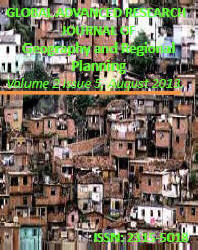
Vol. 2(5) August 2013
Viewing Options:
Abstract
•
Full text
•Reprint
(PDF) (843 KB)
Search Pubmed for articles by:
Hina M
Other links:
PubMed Citation
Related articles in PubMed |
|
Global Advanced
Research Journal of Geography and Regional Planning (GARJGRP)
ISSN: 2315-5108
August 2013
Vol. 2(5): pp. 087-096
Copyright © 2013 Global Advanced Research Journals
Full Length Research
Paper
|
Poorest of the Poor: A Comparative Study of Two
Slums of Central and North East Delhi, India
Ms.
Hina
Research Scholar, Department of Geography, Jamia
Millia Islamia, New Delhi
E-Mail:
hina.geog@gmail.com
Accepted 12 August, 2013
|
|
Abstract |
|
Slums are considered as illegally occupied houses
and creating a nuisance of environmental pollution
and degradation of urban living conditions. Slum
dwellings signify as common phenomena of degraded
life of urban dwelling itself occupied by urban
poor. The presence of slum as a part of urban
habitat refers to a condition of defective physical,
social and economic environment. The present study
is for two slum areas of Delhi i.e., Balmiki
Kabristan ITO and Janta Colony, Seelampur. In India,
Delhi accommodates 4.8% of the total slum population
of India as per 2001 which is relatively above the
India’s average of 15% slum population. This is due
to rapid in migration of unskilled and illiterate
persons from rural areas from densely populated
states like West Bengal, Bihar and Chhattisgarh.
Since all the slums are not lying at same level of
infrastructural development, it is necessary to know
about the basic services and facilities like
drinking water, electricity, sanitation, education
and health services etc between and within the slums
of Delhi. Therefore for this purpose, primary survey
through random stratified sampling was carried out
for 100 households for these two slum areas taking
50 households of each slum. The basic aim of the
study was to compare the living conditions within
the slum through access to basic amenities
facilities and to compare variation between the
slums. Since the study is empirical, no initial
hypothesis is formulated. The data is analysed by
applying appropriate statistical and cartographic
techniques. The major findings of the study is that
the inhabitants of the slums are facing problems
like water supply condition, drainage system,
disposal of garbage, lack of sanitation.
Irrespective of the size and location of slum,
conditions are found to be not conducive for human
survival in these slums.
Keywords: Slums, Migration, Degraded life, Urban
Dwelling, Environment.
|
| |
|
